Published by an official Riot-controlled source or returned by Riot Data Dragon.
Independent research wiki
League Classic Wiki
Track what is confirmed, compare the Season 3 historical baseline, and search Riot Data Dragon records without mixing current announcements with old game data.
- Current signalActively tracked
- Historical datasetData Dragon 3.15.5
- Editorial stanceConfirmed vs pending
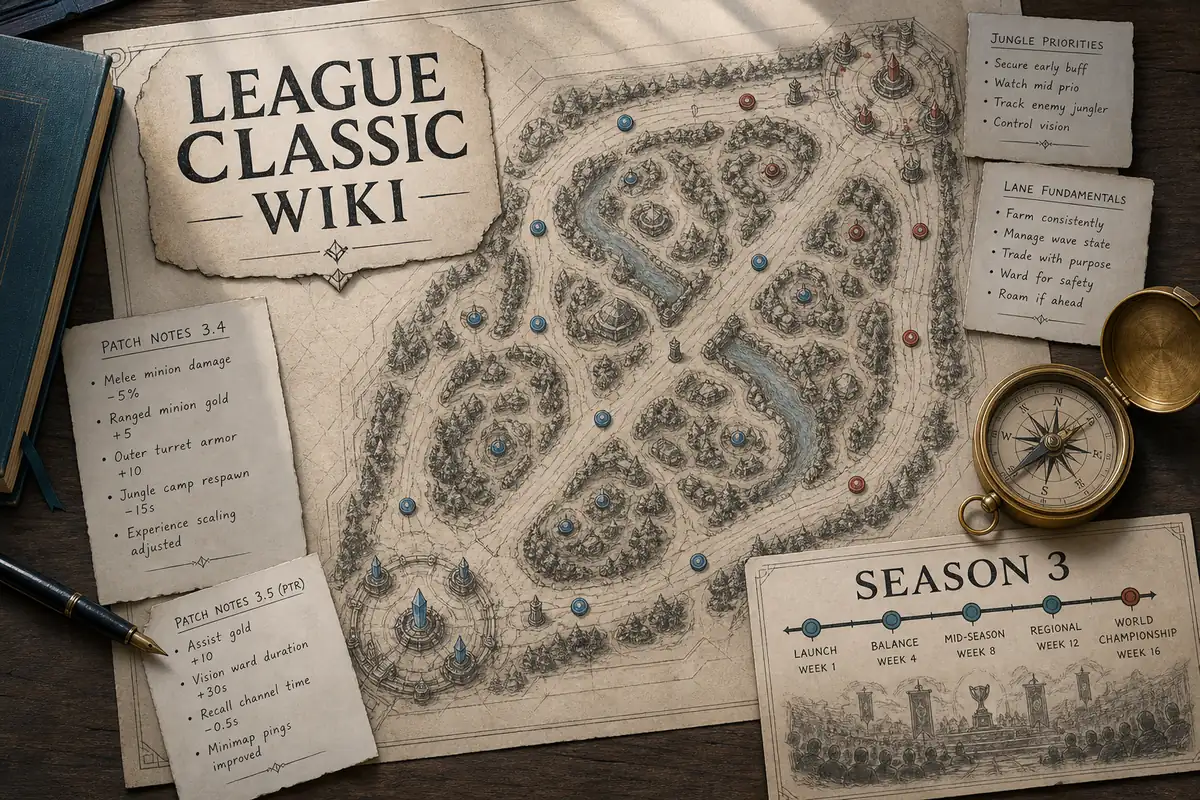
Evidence first
Three labels prevent one common mistake
Interest in League Classic is moving faster than durable documentation. Every statement on this site is assigned a visible evidence state.
Accurate for the named legacy patch, but not automatically part of the current mode.
Popular question or search signal that still lacks a source strong enough to publish as fact.
Start here
What this League Classic reference covers
League Classic searches often combine three different questions: what Riot has announced now, what League of Legends looked like during Season 3, and which historical systems might return. Those questions need separate answers. A legacy champion or item appearing in Riot's old dataset proves that it existed in that patch; it does not prove that Riot has selected it for a present-day mode.
This site therefore uses a two-layer model. The current-status layer records official availability, dates, platform details, and roster confirmations only when a source can be checked. The historical layer provides a searchable snapshot from Data Dragon 3.15.5 so readers can inspect the real names, roles, tags, prices, and item descriptions associated with a late Season 3 client dataset.
The result is useful even while details are changing. Returning players can rebuild context, new players can understand why Season 3 is discussed, and researchers can see exactly which claims remain unresolved.
Reference desk
Explore the evidence by task
Current status
See which release, access, roster, and rules questions are confirmed or still pending.
Historical roster
Filter Riot's 3.15.5 champion dataset by name, title, or role tag.
Season 3 items
Search purchasable items and historical gold totals from the same Data Dragon build.
Research timeline
Understand the difference between the 2013 baseline, current demand, and future confirmations.
Season 3 vs League Classic
Compare the 2013 historical baseline with current League Classic claims before using roster or item data.
LoL old runes and masteries
See how Marks, Seals, Glyphs, Quintessences, rune pages, and the three mastery trees work in League Classic.
League Classic release date
Check release-date, launch-time, region, and patch claims against the right source layer.
League Classic CDR vs Ability Haste
See what historical item data shows, what the current Classic sources leave open, and how to verify a future mechanics update.
League Classic items
Separate the current item-pool question from the historical Data Dragon item database.
League Classic builds
Build a source-checked rune, mastery, and item plan without confusing historical data with a current meta.
League Classic tier list
Separate a current ranking claim from historical data, roster evidence, and pending balance questions.
Editorial method
How updates are accepted
An update enters the confirmed layer only when it can be traced to Riot Games, an official League of Legends property, or a Riot-hosted machine-readable dataset. Community posts and videos can identify questions worth checking, but they do not establish roster or balance facts by themselves.
Historical values always carry a patch label. When Riot changes a current announcement, the status page records the checked date and replaces the outdated statement instead of silently blending versions. This keeps search-friendly summaries from becoming misleading shortcuts.
Dataset endpoint: Riot Data Dragon 3.15.5 champion data. Current-mode claims are tracked separately.
Practical guide
How to use a classic-game wiki without importing the wrong patch
Begin with the question, not the remembered answer
A useful search usually has a time boundary hidden inside it. “Was this champion in Season 3?” is a historical lookup. “Can I pick this champion in League Classic?” is a current roster question. “Did this item cost 2,100 gold?” is incomplete until a patch is named. Start by deciding which of those questions you are asking, then choose the matching page and evidence label.
The historical roster is the fastest route for names, titles, resource labels, and broad Data Dragon tags. The item database is better for names, plain descriptions, and gold fields. Neither table should be used to infer a launch schedule, queue format, modern client behavior, or current balance changes. For those questions, open the current status tracker and check whether the claim is confirmed or pending.
Read “historical” as a boundary, not a warning to ignore
Historical data remains valuable because it narrows the discussion to something reproducible. Instead of relying on memory or a screenshot with no date, a reader can open the same Riot-hosted JSON version and find the same record. That makes comparisons possible. It also exposes where nostalgia compresses a year of patches into one imagined ruleset. Season 3 changed over time; Data Dragon 3.15.5 is one labeled late-season snapshot, not every moment of 2013.
A modern classic mode may preserve recognizable pacing or content while changing technical systems, bug fixes, accessibility, matchmaking, security, or balance. Those differences do not make the historical baseline useless. They make version labels more important. The baseline tells us what existed in the selected source; current official documentation tells us what Riot chose to ship now.
Common mistakes
Four claims this site will not manufacture
High search demand can reward fast answers, but an answer without a source creates more confusion than value.
A guessed release date
A countdown, event date, or regional opening will not be published from an unattributed snippet. The status ledger needs an accessible Riot-controlled source and a review date.
A “confirmed” roster copied from history
The 117 champion records in the historical tool are not automatically eligible for a current mode. Historical existence and current selection are separate facts.
A fake calculator
The site does not offer a damage, build, or economy calculator until the necessary rules and data can support real calculations. A decorative form that returns invented values would mislead users.
An unofficial download or Play button
This reference does not host clients, APK files, installers, or embedded copies of the game. Access instructions must point readers toward verified official channels.
Data literacy
What each field can and cannot tell you
Champion name and title identify the record in the selected Data Dragon release. A title can later change, so it should not be treated as a permanent canonical subtitle. Role tags are broad client classifications, not a promise about a lane, professional role, or current recommended build. Resource describes the historical record’s resource label and may not capture special kit rules.
Item total gold is the historical total cost field. Base gold is not necessarily the amount a player always paid at the shop; recipes, components, map availability, and transformations affect interpretation. Plain descriptions are useful search text, but machine-readable formatting can omit the surrounding rule context a player needs.
The source policy is intentionally conservative because corrections become harder once a claim spreads across translated pages. A current fact is added first to the English status ledger with its source and review date. Only then should it be localized. This sequence keeps every language aligned with the same evidence rather than translating a rumor eight times.
League Classic questions
Is the Season 3 roster the confirmed League Classic roster?
No. The roster page is a historical Data Dragon 3.15.5 baseline. A champion is marked current only after a separate official confirmation.
Why use Data Dragon 3.15.5?
It is a Riot-hosted late Season 3 dataset that provides structured champion and item records. The exact version is shown so readers can reproduce the reference.
Does this site belong to Riot Games?
No. League Classic Wiki is an independent reference and is not endorsed by Riot Games. League of Legends and related marks belong to their respective owners.
How often is current status checked?
The status page shows its reviewed date. Fast-changing claims remain pending until an official source can be verified.