
The short answer for a League Classic tier list is careful: the accessible Riot sources checked for this guide identify a current Classic champion roster and describe the product, but they do not publish a complete, current all-champion strength ranking. That means an unversioned S/A/B list should be treated as a third-party claim until its patch, mode, region, sample, and review date are visible.
Search demand is useful for discovering the question, not for answering it. Similarweb shows `league classic tier list` as an informational query with a monthly average volume of 4,764 and a recent 28-day window volume of 136,380 in its global country=999 keyword-generator scope. Those numbers explain why players want a ranking; they do not establish which champion is strongest.
A tier list is also different from a roster or a build guide. The official roster page answers who Riot currently lists. A build guide explains how to assemble runes, masteries, and versioned items. A tier list makes a comparative claim about power, and that claim needs a current balance source and a method that can be reviewed.
This guide gives you a practical way to read a ranking without pretending that missing data is confirmed. It separates official facts, historical observations, current measurements, community experience, and pending questions. When Riot publishes a readable rules or balance source, the evidence ledger can be updated without rewriting history into the present.
Quick verdict: what this site can confirm
| Complete current all-champion tier list | Not confirmed by the readable Riot sources checked for this guide. |
|---|---|
| Official Classic roster | Riot's checked champions page lists 60 champions; a roster is not a power ranking. |
| Historical evidence | Data Dragon 3.15.5 can reproduce labeled champion and item records from its snapshot. |
| Current champion strength | Needs a named patch, mode, region, sample, methodology, and review date. |
| Safe page format | Show evidence status and scope instead of unversioned S/A labels presented as fact. |
Why “League Classic tier list” needs a source boundary
The word “tier” compresses several decisions. A player may mean a solo-queue ranking, a tournament ranking, a lane-specific list, an easy-to-play list, or a historical Season 3 comparison. These are not interchangeable. A champion can be strong in one mode, patch, role, or skill band and ordinary in another. A page that hides those dimensions may look decisive while giving the reader no way to reproduce the result.
The current official roster is a useful starting set, but it does not supply win rate, pick rate, ban rate, matchup data, item values, queue rules, or a balance tier. The historical Data Dragon file is useful for versioned names and records, but it is not a current Classic balance feed. The evidence becomes misleading only when a source is asked to prove more than it contains.

For this reason, the safest answer today is not “every champion is unranked.” It is “a complete current ranking is not confirmed here.” That wording leaves room for a future official patch or a transparent community sample to add evidence. It also gives readers a concrete checklist for judging the rankings they find elsewhere.
What each evidence layer can prove
Use the strongest source that matches the claim. A source can be valuable and still be the wrong evidence for a tier label.
| Evidence layer | Useful for | It cannot prove |
|---|---|---|
| Official champion page | The current listed champion set and official entity spelling. | Which champion has the highest win rate or best matchup. |
| Riot Data Dragon 3.15.5 | A reproducible historical record of names, tags, descriptions, and versioned fields. | The current Classic shop, balance, map, queue, or tier. |
| Current patch or match sample | A dated measurement of performance within a named mode, region, rank, and sample. | A universal ranking outside that sample or after the patch changes. |
| Community tier list | Player hypotheses, practical context, and questions worth checking. | An official Riot decision or a methodology-free universal truth. |
| Search demand | The wording players use and the questions worth answering. | Any champion strength, roster choice, or gameplay rule. |
How to audit a League Classic tier list in 5 steps
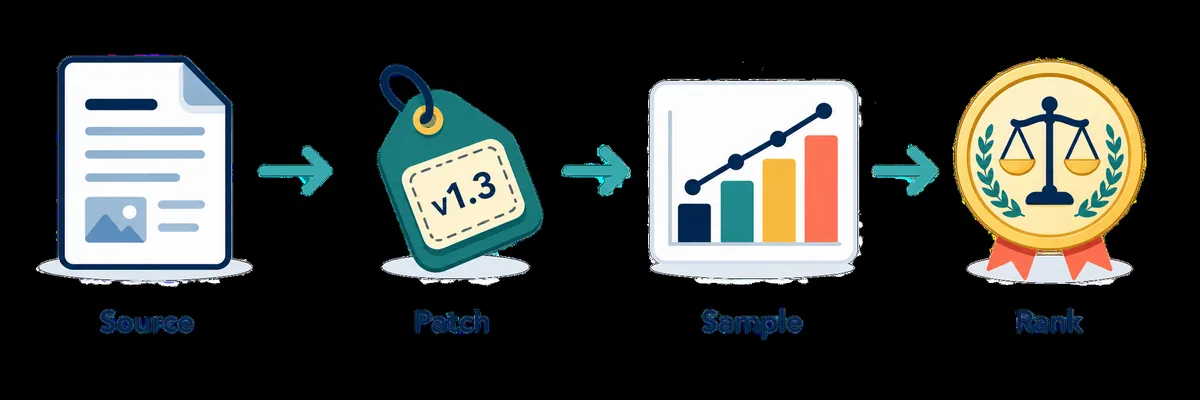
- 1. Define the ranking questionWrite down whether the list means strongest overall, best by lane, easiest for beginners, strongest for a tournament, or a historical comparison. If the page does not say, its labels are underspecified.
- 2. Lock the patch and modeRecord the patch or build, map, queue, region, and access stage. “League Classic” alone is not enough to tell a reader which rules and data the list used.
- 3. Check the champion setCompare the ranked names with the official 60-name roster when the claim is current. Use the historical roster only for a named Data Dragon snapshot, and do not silently add old records to a current pool.
- 4. Inspect the sample and methodLook for games, rank bands, date range, source API, matchup handling, ban or pick filters, and the reason a champion moved. A tier label without a sample is an opinion, not a measurable result.
- 5. Keep the update boundary visibleA ranking needs a review date and a rule for stale data. When the patch or official roster changes, update the claim, its metadata, its FAQ, and the links that point to it.
Current ranking vs historical champion research
These two page jobs can use the same game entity while answering different searches.
| Reader question | Best destination | Reason |
|---|---|---|
| Which champions does Riot list for Classic? | Official roster guide | The question is about inclusion and official naming, not comparative strength. |
| Which champion was in the late Season 3 data? | Historical roster and item database | The version label makes the old record reproducible. |
| Which champion is strongest now? | Current patch data or a dated methodology-led list | Power depends on the measured mode, region, rank, patch, and sample. |
| How should I assemble a setup? | League Classic builds guide | Runes, masteries, and items require a configuration workflow rather than a tier label. |
Common tier-list traps
- Calling the official roster a tier list. Inclusion tells you who is listed, not who wins more games.
- Importing modern Runes Reforged or current item advice into an old-rules question without checking the system boundary.
- Using Data Dragon 3.15.5 as if it were a live Classic balance endpoint. It is a labeled historical snapshot.
- Treating a community list, video, or search snippet as an official Riot ranking. Those sources can be useful leads but need attribution and scope.
- Hiding the region, rank, queue, or date. A list without scope cannot tell readers whether its result applies to their match.
FAQ: League Classic tier list and rankings
Is there a confirmed League Classic tier list?
This site has not found a readable Riot-controlled source that publishes a complete current all-champion strength ranking. A third-party list may still be useful, but check its patch, mode, sample, region, method, and review date before calling it confirmed.
Which champions are on the League Classic tier list?
Riot's checked League Classic champions page lists 60 champions, but that is an official roster rather than a tier list. Use the roster guide for inclusion and keep comparative strength claims separate.
Can Season 3 data create a current League Classic tier list?
No. Data Dragon 3.15.5 can support historical research about its own records. It does not prove the current Classic balance, item pool, map, queue, or champion strength.
Are League Classic builds and tier lists the same thing?
No. A build guide explains a configuration and its evidence boundary. A tier list compares champion strength and needs a current, transparent data method. The two pages can link to each other without sharing the same intent.
Will League Classic have ranked or role-specific tiers?
The checked sources do not provide a complete ranked-mode or role-specific tier specification for this page. Treat ranked, lane, and queue questions as pending until a current source names the scope.
How often should a League Classic tier list be updated?
After any patch, roster change, mode change, or meaningful sample change. The page should show the review date and preserve the old version rather than silently blending different datasets.
Sources and evidence limits
- Riot League Classic champions page - Current official roster source checked for the 60-name boundary.
- Riot developer article about League Classic - Official product context; it is not a complete current balance table.
- Riot League Classic landing page - Official product entry point to re-check when current scope changes.
- Riot Support: League Classic Runes and Masteries - Useful for the documented legacy system; it does not establish a champion tier.
Continue with the right evidence layer
Official League Classic roster
Check the 60-name official list without turning it into a ranking.
League Classic builds
Plan runes, masteries, and versioned items with a source boundary.
League Classic items
Search historical item records and keep patch context visible.
Current status tracker
Follow access, release, and other claims that need a current source.