Searches for the League Classic map usually hide several different questions. A player may be asking which arena is playable now, whether the mode uses Summoner’s Rift, whether its layout matches a particular Season 3 patch, or whether a screenshot belongs to the Classic client. Those questions sound alike, but each needs a different kind of proof.
As of October 24, 2026, the Riot-controlled material reviewed for this guide gives product and gameplay context, but the readable public sources available in this review did not establish a complete current map specification. The official landing pages were requested directly and returned an anti-bot shell instead of readable map details. That is a limit of this check, not proof that Riot has no internal map specification or that the game contains no map.
The useful short answer is therefore bounded: do not state a map name, queue, region rollout, or exact Season 3 version as confirmed unless a current Riot source names it. The official gameplay still below is real Riot-published context, but a cropped lane view cannot prove the full arena. Historical map references remain useful when they are labeled with their patch and kept separate from current claims.
Quick answer: what map does League Classic use?
| Current public map specification | Not established by a readable, dated source in this review. |
|---|---|
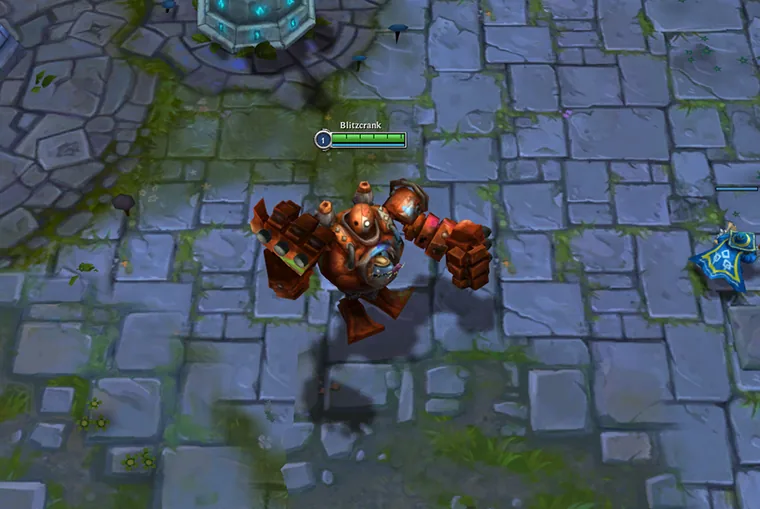
| Official visual context | Riot’s developer article includes a Classic-style gameplay still with a stone lane. |
| What one still proves | Only that the pictured scene appeared in that Riot-published context; it does not identify a full map or all queues. |
| Season 3 comparison | Use a named historical patch or source; “Season 3” covers more than one changing game state. |
| Safe update rule | Promote a map claim to confirmed only when Riot states the map or mode scope in a current source. |
“Map” can mean more than one thing
Name the question before choosing a map name
In a search query, “map” can refer to the arena geometry, the game mode, a queue, a regional rollout, a minimap image, or the patch that supplied a particular layout. A page that answers only “Summoner’s Rift” without saying which of these it means may sound confident while leaving the real question unresolved. For a current claim, look for the mode and the scope named in the same source.
Treat screenshots as partial evidence
A gameplay image is useful evidence, but it is not equivalent to a map announcement. A screenshot can show a champion on stone paving, a lane, or a base structure. Unless the image includes a verifiable minimap or is accompanied by Riot text naming the arena, it does not establish the full layout, side objectives, queue rules, or whether the scene represents every region and release phase.
Keep the product state tied to a date
The word “Classic” also does not automatically mean a frozen copy of one 2013 patch. Riot may preserve a recognizable visual style while changing technical systems, fixing bugs, adjusting accessibility, or selecting a limited content pool. Those possibilities are not claims about what Riot has done; they explain why a dated current source matters more than a remembered visual.
What each source can establish
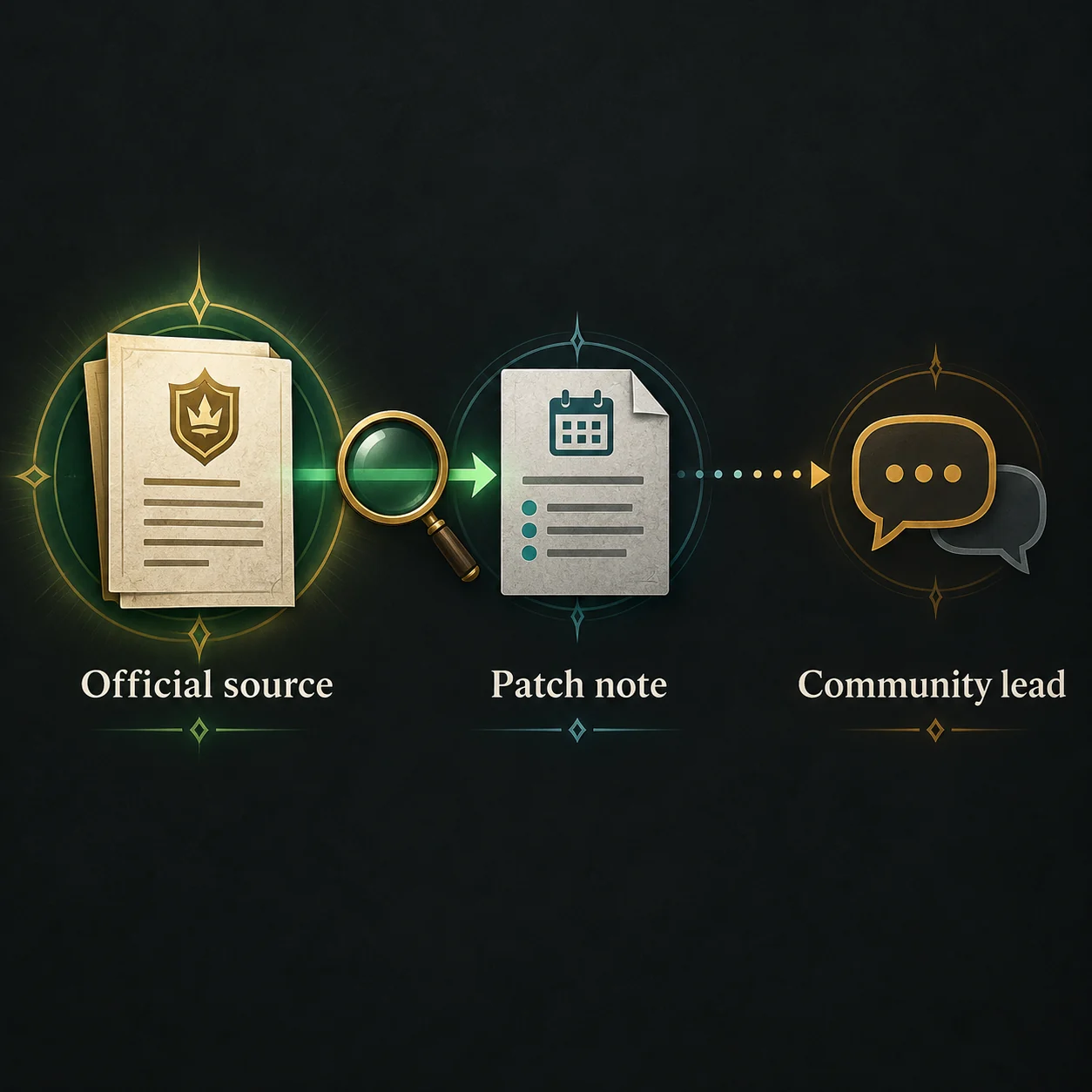
Match each sentence to the source that can actually support it. Strong sources still have limits: a product page is not necessarily a full map specification, and historical data is not a current client record.
| Source type | Useful for | Does not establish by itself |
|---|---|---|
| Current Riot product or support page | A map or mode claim when the page names it and gives a current scope. | Details that the page does not mention, such as every queue or regional rollout. |
| Dated Riot patch note or announcement | A versioned change, map update, or rollout when the note names its target. | A permanent rule outside the dated change or an unannounced future plan. |
| Riot developer-article gameplay still | Visual context for the scene shown in the article. | The complete arena, exact client build, map rotation, or all current regions. |
| Season 3 article or Data Dragon snapshot | Historical context tied to the named period or data version. | The map currently used by League Classic. |
| Community post, clip, or screenshot | A lead to investigate and a record of what a player saw. | An official map confirmation without a traceable Riot source. |
How Season 3 map history fits the question
Season 3 describes a changing period
Season 3 was a period of updates, not a single immutable map snapshot. A guide or image from early 2013 may not describe the same client state as a later patch. When a historical source names a patch, preserve that label in your note and link it to the historical comparison page rather than quietly treating it as a current specification.
Use Data Dragon only for fields it contains
Data Dragon 3.15.5 is useful on this site for reproducible champion and item records. It should not be used as a direct map database: a champion JSON file does not prove arena geometry, queue availability, or current map selection. If a separate historical map source is used, identify its author, date, patch, and exact claim before comparing it with a current Riot announcement.
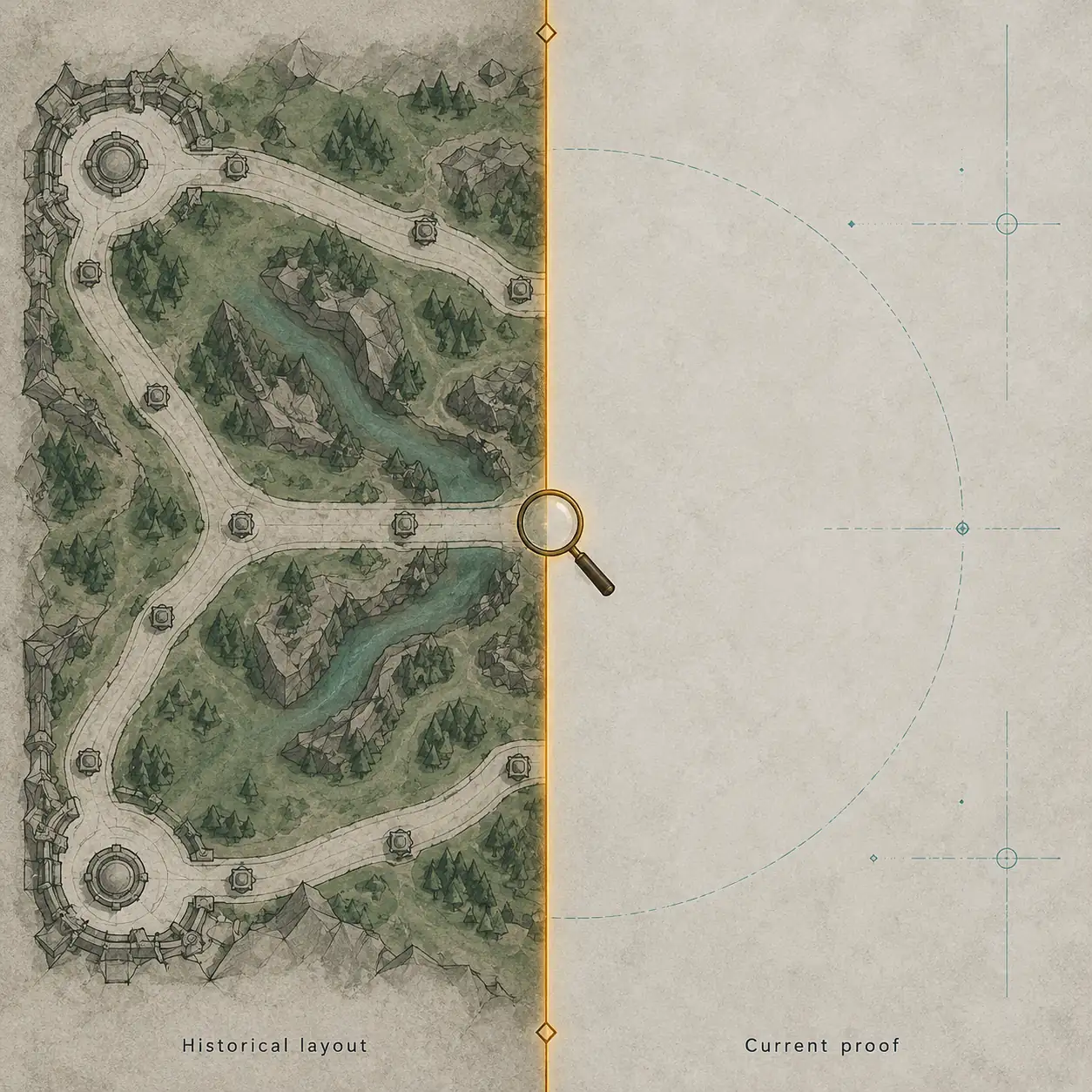
Compare current and historical evidence side by side
A clear comparison keeps two columns mentally separate: “what a named historical source records” and “what current Riot material says.” If the current column is empty, say that the public source was not found during the review. Do not fill the blank with a screenshot that lacks a map-wide view or with a familiar memory from a different patch.
Five checks before calling a map confirmed
- 1. Name the scopeIs the claim about the arena, a queue, a game mode, one region, or a dated test?
- 2. Open the primary sourcePrefer Riot’s current product page, support article, client notice, or dated patch note.
- 3. Record version and dateCapture the page URL, publication or update date, patch, region, and stated rollout scope.
- 4. Read visuals narrowlyA lane screenshot supports visual context; it is not a substitute for a named map specification.
- 5. Keep history in its laneLabel Season 3 references with the original patch and link the historical comparison separately.
What this page does not prove
- It does not prove that League Classic currently uses Summoner’s Rift or any other named arena.
- It does not prove which queues, regions, map rotations, objectives, or future rollout dates are active.
- It does not convert a Riot gameplay still into a full map image or a statement about every client build.
- It does not treat a Season 3 patch or Data Dragon record as a current map specification.
- It does not present community clips or generated illustrations as official game footage.
FAQ: League Classic map
What map does League Classic use?
The readable, dated Riot sources available in this review did not establish a complete current map specification. Check a current Riot product page, support article, or patch note before naming the arena.
Is Summoner’s Rift confirmed for League Classic?
This review cannot confirm that from an accessible, map-specific current Riot statement. A familiar lane screenshot is not enough to make the claim.
Is the League Classic map the same as Season 3?
That has not been established here. Season 3 changed over time, so a comparison needs a named historical patch and a current Riot source describing the Classic version.
Does the official gameplay screenshot prove the map?
No. The Riot developer-article still shows a cropped stone-lane scene. It supports visual context, not a complete arena layout, queue, region, or current build.
Where should I check for a League Classic map update?
Start with Riot’s Classic product page, current support material, developer announcements, and dated game updates. Record the URL and the version or region named by Riot.
Can Data Dragon 3.15.5 confirm the current map?
No. The champion JSON is a historical entity dataset, not a current map or queue specification. Use it only for the fields it actually contains.
Sources and checked boundaries
- Riot League Classic landing page - Official product entry point; the readable map details were not available in this session’s direct page response.
- Riot developer article about League Classic - Official product context and gameplay image; not a complete map specification.
- Riot game updates archive - Check dated first-party change notes when Riot publishes a map or mode update.
- Riot Data Dragon 3.15.5 champion JSON - Historical champion records only; not evidence of the current map.
Open the guide that matches your question
Current status tracker
Follow current, historical, and pending claims.
Season 3 vs League Classic
Compare the historical period without treating it as a current specification.
League Classic patch notes
Check dated changes and keep unsupported version claims pending.
Official League Classic roster
Verify the current champion list separately from map details.