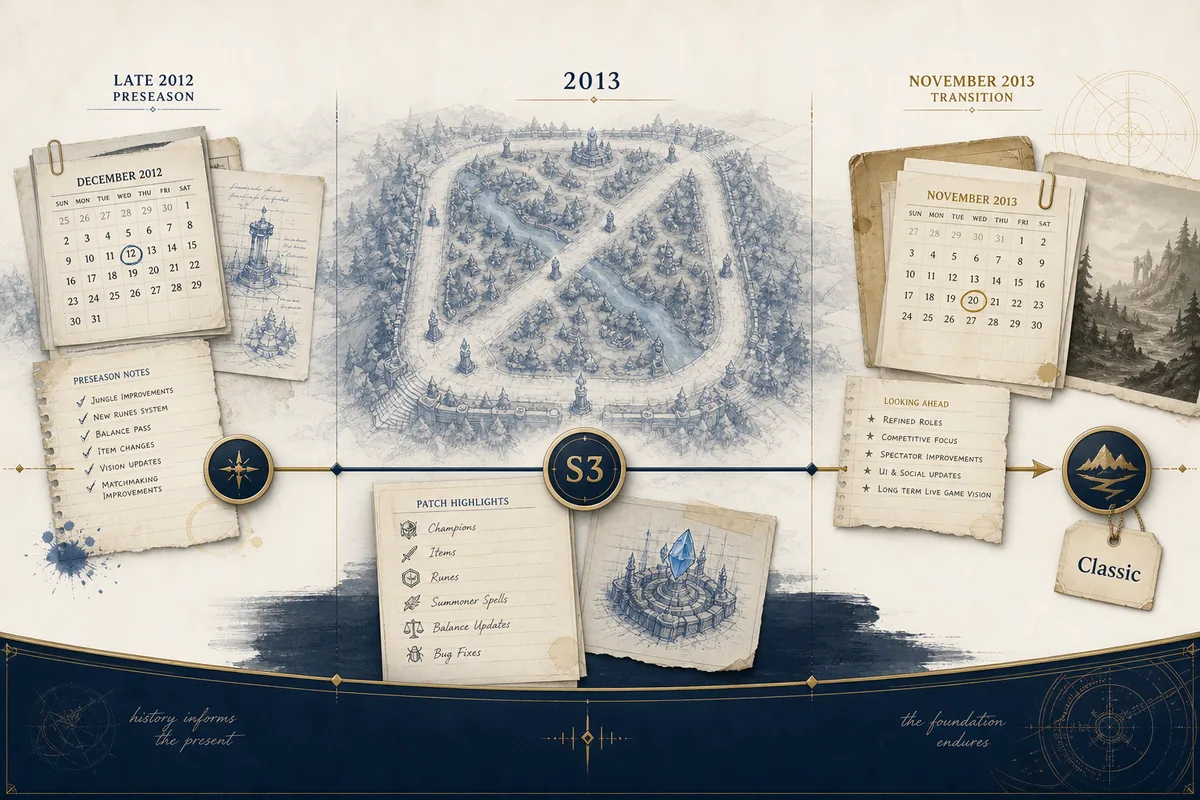
If you are asking, “when was Season 3 of League of Legends?”, the short answer is February 1, 2013 through November 12, 2013 for the historical ranked and competitive season window. That is the most useful date range for a reader who wants to place Season 3 on a calendar. It is not the same as saying that every patch, champion, item, or competitive rule stayed unchanged across those months.
The confusion comes from the word season. League of Legends had a preseason, a formal competitive-season start, patch releases, regional server clocks, and a World Championship that occupied only part of the year. A page that reports one date without naming the milestone can be technically accurate and still answer the wrong question.
This guide fixes that problem by separating four things: the preseason beginning on November 20, 2012, the Season 3 start marker on February 1, 2013, the November 12, 2013 end record, and the late-season Data Dragon 3.15.5 snapshot used elsewhere on this site. The dates are historical context, not a current League Classic release announcement.
Quick answer
| Season 3 start | February 1, 2013 The historical source describes this as the end of preseason and the official start of the Season 3 Champion Series. |
|---|---|
| Season 3 end | November 12, 2013 The V3.13 historical record marks the season as ended on this date; local time can make summaries show November 11. |
| Preseason context | November 20, 2012 Season 3 changes and preparation began before the formal February start marker. |
| Historical data used here | Data Dragon 3.15.5 A reproducible late-season snapshot, not a complete record of every Season 3 patch. |
Season 3 dates at a glance
Use the table below when a search result, video, or forum post says “Season 3” without making its time boundary explicit.
| Milestone | Date | How to interpret it |
|---|---|---|
| Preseason began | November 20, 2012 | This is the start of the preseason context, not the formal ranked-season start. |
| Season 3 start marker | February 1, 2013 | The best short answer for when the formal Season 3 competitive window began. |
| Season 3 World Championship | October 4-6, 2013 | A major event inside the season, not the date the ranked season ended. |
| Season 3 ended | November 12, 2013 | The historical V3.13 record gives this end marker; account for time-zone wording when comparing sources. |
| Late-season data snapshot | Data Dragon 3.15.5 | A version label for reproducible champion and item records, not a calendar date. |
Why February 1, 2013 is the useful start date
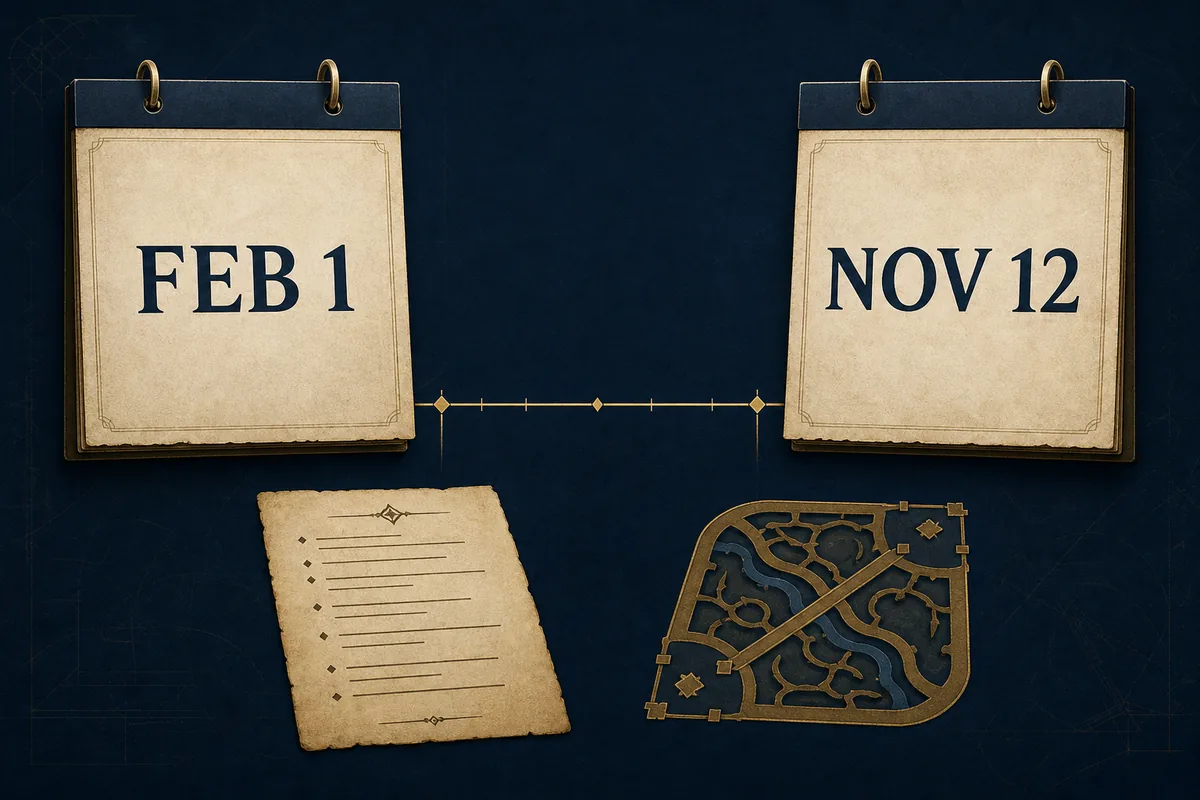
A preseason can already contain the systems that players associate with the next season. The historical Season Three page describes a preseason beginning on November 20, 2012 and patch changes beginning on December 4, 2012. Those changes included new masteries, item changes, summoner-spell changes, and other system work. If someone asks when Season 3 content first appeared, December 2012 may be the relevant answer. If they ask when Season 3 formally began, February 1, 2013 is the cleaner answer.
That distinction is especially important for old guides. A screenshot from preseason can look like Season 3 while carrying a different patch, balance state, or item recipe from the formal season. When you cite a champion ability, item cost, mastery, or map rule, keep the patch number beside the season label. “Season 3” describes an era; a patch describes the state of the game at a particular point in that era.
Why November 12, 2013 needs a time-zone note
The historical V3.13 record marks Season 3 as ending on November 12, 2013. Some summaries and player memories use November 11 because the end time was experienced in a different regional clock or because the source was written before the final local transition. The safe editorial wording is “the historical end record is November 12, 2013; some regional summaries show November 11.” That preserves the evidence without pretending that every server used the same wall-clock date.
Do not use the World Championship dates as the end of Season 3. The championship ran October 4-6, 2013, which is an important event window but not the ranked-season close. Likewise, patch 3.14 arrived after the V3.13 end record and belongs to the next-season transition context. These markers are close together, so a date table is more reliable than a single sentence copied from memory.
Season 3 dates are not League Classic dates
A historical date answers when an old League of Legends season was active. It does not confirm that a modern League Classic product launched on the same day, uses the same patch, or includes every system that existed in 2013. Current claims about access, regions, roster, maps, queues, progression, and economy need current Riot-controlled evidence.
The same rule applies to this site’s historical tools. Data Dragon 3.15.5 can show what its champion and item JSON contained. It cannot prove that every listed champion or item belongs to a current Classic pool. The official League Classic roster page and the status tracker have a different job: they preserve current source boundaries and visible review dates.
This separation is the information gain of the page. Instead of flattening preseason, ranked season, championship, patch, and current-product dates into one “Season 3” label, it gives each date a job. Readers can then use the Season 3 comparison guide for broader historical differences and this page for the direct date question.
How to verify a Season 3 date in four steps
- 1. Name the milestoneDecide whether you mean preseason, formal ranked-season start, World Championship, patch release, or season end.
- 2. Attach the source typeUse a historical season page for calendar context, a patch record for a patch date, and Riot Data Dragon for a versioned data snapshot.
- 3. Keep the region caveatIf a source says November 11 or November 12, check whether it is describing a local server clock or a UTC-style date.
- 4. Do not promote history to current statusLink current League Classic questions to the status tracker and official roster guide instead of inferring from 2013.
What these dates do not prove
- They do not prove the release date, access model, or supported regions of League Classic.
- They do not prove that every Season 3 champion, item, rune, mastery, map, or queue is restored unchanged.
- They do not turn Data Dragon 3.15.5 into a complete record of every patch in the 2013 season.
- They do not establish a current balance recommendation, tier list, build, or competitive rule.
FAQ: When was League of Legends Season 3?
When was Season 3 of League of Legends?
For the historical ranked and competitive window, the clearest short answer is February 1, 2013 to November 12, 2013. Preseason began on November 20, 2012, so older system changes may appear before February.
Did League of Legends Season 3 start in 2012 or 2013?
Both dates can appear for different milestones. Preseason began in November 2012, while the formal Season 3 start marker is February 1, 2013.
Did Season 3 end on November 11 or November 12?
The historical V3.13 record uses November 12, 2013. November 11 can appear in regional or time-zone summaries, so cite the source wording when precision matters.
Was Worlds 2013 the end of Season 3?
No. The Season 3 World Championship took place October 4-6, 2013, inside the season. The historical end record came later in November.
Is Season 3 the same as League Classic?
No. Season 3 is a 2013 historical period. League Classic is a current product and source question; current details need current Riot evidence rather than old dates alone.
Sources and evidence
- League of Legends Wiki: Season Three - Community-maintained historical reference for the preseason and February 1, 2013 start marker.
- League of Legends Wiki: V3.13 - Community-maintained patch reference that records the November 12, 2013 Season 3 end marker.
- Riot Data Dragon 3.15.5 champion JSON - Official Riot-hosted historical data source used as a versioned late-season snapshot.
- Riot League Classic champions page - Current official source used to keep League Classic claims separate from 2013 history.
Continue with the right page
Season 3 vs League Classic
Use the comparison guide for broader historical differences and evidence boundaries.
Research timeline
Follow the chronology from the 2013 baseline to current verification conditions.
Current status tracker
Check current availability, access, regions, and pending claims.
Historical item database
Look up versioned item names and gold fields without treating them as current rules.